Market overview
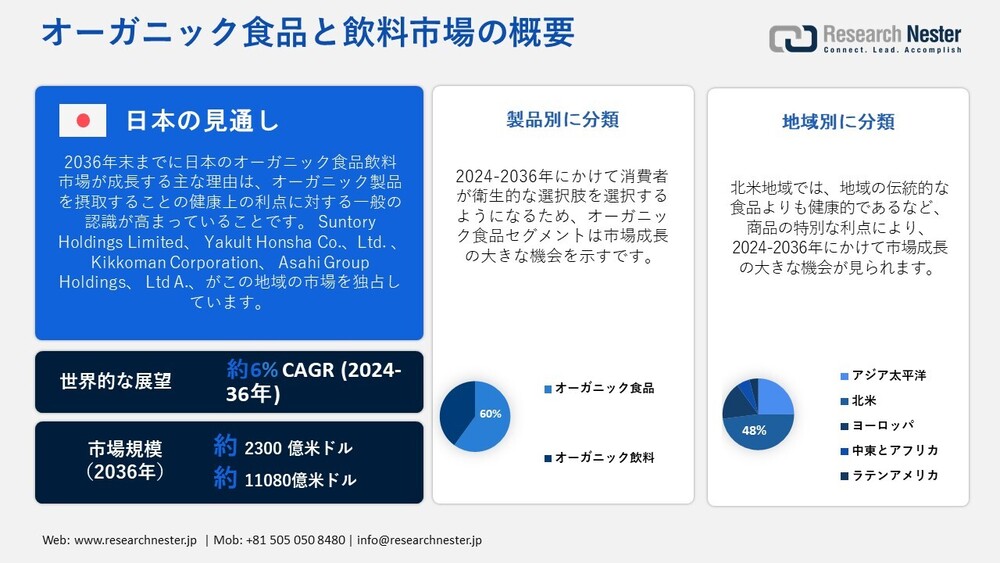
The organic food and beverage market is projected to exceed US$230 billion in 2023 and reach US$1.108 trillion by the end of 2036, growing at a compound annual growth rate (CAGR) of 6% during the forecast period from 2024 to 2036. In 2024, the organic food and beverage industry was valued at approximately US$262 billion.
The main driving force behind market expansion is the growing public awareness of the health benefits of consuming organic products. Shifts in consumer purchasing behavior are expected to drive increased sales of organic food and beverages. According to the latest 2022 data from the U.S. National Library of Medicine, the industry size in 2020 was €120.6 billion, with the U.S. being the largest market. Furthermore, increasing consumer preference for non-GMO products is boosting market expansion. The market has grown significantly as access to organic food and beverages has become easier. Organic products can no longer be found only at farmers' markets and specialty stores.
Regional analysis
The Kanto region holds the largest share of Japan's organic food and beverage market. High consumer purchasing power, growing health consciousness, and the proliferation of upscale supermarkets support robust demand in this region. Urban professionals and health-conscious families continue to drive the purchase of organic fruits, vegetables, dairy products, and beverages.
The Kansai region , particularly Osaka, Kyoto, and Kobe, is emerging as a new and important market due to rising demand for high-end food products and increasing awareness of sustainable living. Restaurants, cafes, and specialty shops are expanding their selection of organic products to meet changing consumer preferences.
Request a sample report here:
https://www.researchnester.jp/sample-request-analysis-3270
Segment analysis
The market can be segmented by product type, distribution channel, and end-user .
Looking at product categories, organically grown fruits and vegetables hold a large market share due to the growing consumer preference for fresh, pesticide-free produce. Organic dairy products, cereals, grains, snacks, baby food (desi khand, khandsari sugar) and beverages are also expected to see stable demand. Among beverages, organic green tea, herbal tea, coffee, fruit juices, and plant-based drinks continue to be popular among health-conscious consumers.
Looking at distribution channels, supermarkets and hypermarkets remain major sales channels due to their wide selection and certified organic brands. However, online retail platforms are experiencing the fastest growth, supported by convenient home delivery services, subscription services, and a broad range of products. Consumers seeking high-quality, locally sourced organic products also continue to be drawn to organic specialty stores and farmers' markets.
From the end-user's perspective, the majority of demand comes from ordinary household consumers. At the same time, hotels, restaurants, cafes, educational institutions, and medical facilities are increasingly incorporating organic ingredients into their food services to meet evolving customer expectations.
You can view the detailed report here: https://www.researchnester.jp/industry-analysis/organic-food-and-beverages-market/3270
Growth drivers (2024-2036)
Several factors are expected to drive the growth of the Japanese organic food and beverage market throughout the forecast period.
- Increased consumer awareness regarding nutrition, food safety, and preventive medicine.
- There is a growing preference for foods that are pesticide-free, non-GMO, and grown using natural farming methods.
- The spread and expansion of sustainable agricultural practices, supported by government initiatives.
- Expansion of e-commerce platforms and direct-to-consumer distribution channels.
- A diet centered on plant-based foods and functional organic beverages are gaining popularity.
Future Outlook
The Japanese organic food and beverage market is expected to maintain strong growth until 2036 as consumers increasingly prioritize health, sustainability, and product transparency . Advances in organic farming technology, the expansion of certification systems, and increased investment in environmentally conscious agricultural practices will further drive market development. Companies focusing on high-quality products, clean-label raw materials, sustainable packaging, and digital retail strategies are expected to gain a competitive advantage. As consumer demand continues to shift towards healthier and more environmentally conscious lifestyles, the organic food and beverage market has the potential to become one of the most dynamic segments in the Japanese food industry during the forecast period.
contact address
Email address: info@researchnester.jp
Japanese phone number: +81 505 050 8480
Source: Japan Market Research Company - Research Nester Japan
こちらの記事もおすすめ